

Zellij
Copy pageZellij can be used as an alternative to tmux. Detected automatically via $ZELLIJ.
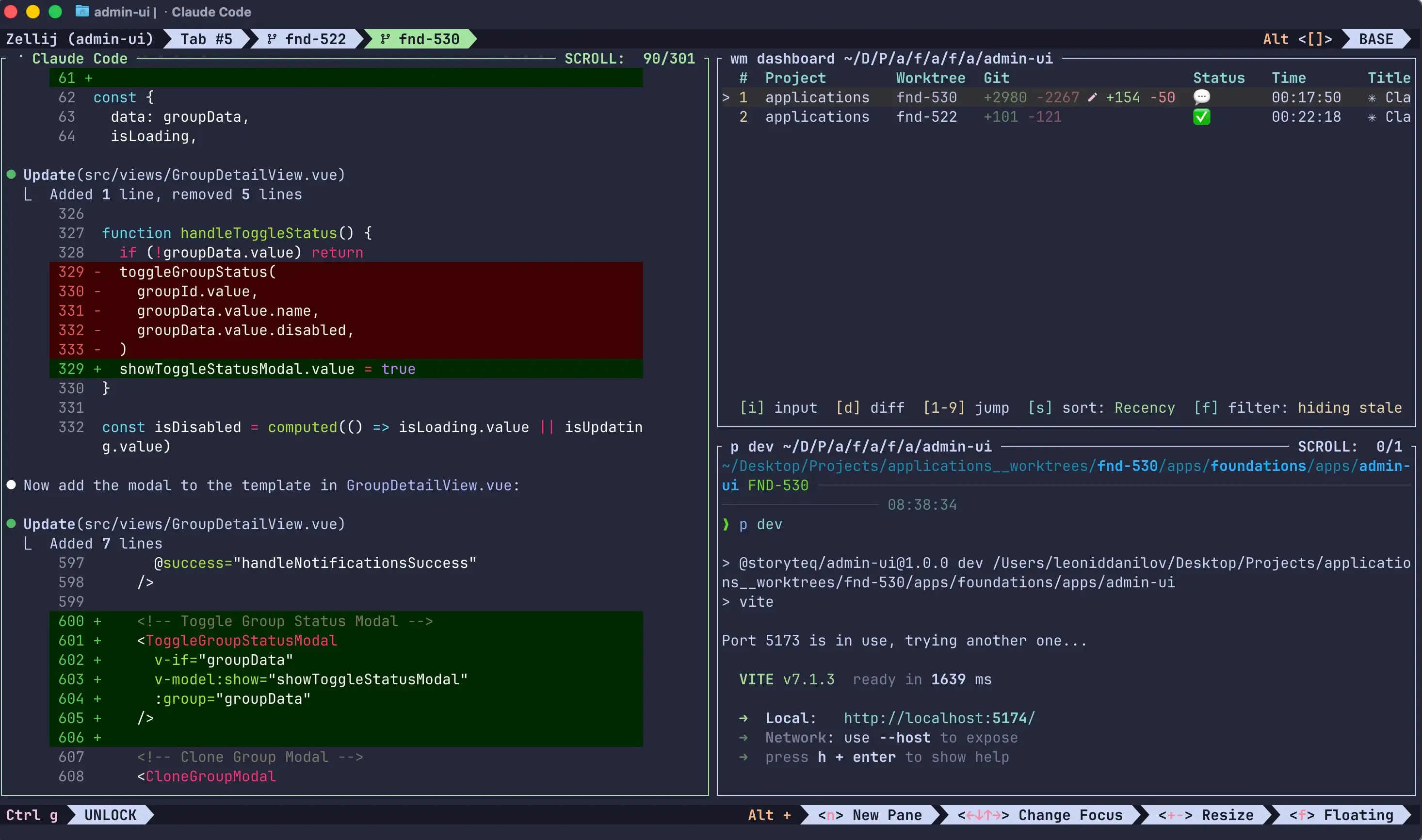
Differences from tmux
Section titled “Differences from tmux”| Feature | tmux | Zellij |
|---|---|---|
| Agent status in tabs | Yes (window names) | Yes (tab titles) |
| Tab ordering | Insert after current | Appends to end |
| Scope | tmux session | Zellij session |
| Session mode | Yes | No (window only) |
| Pane size control | Percentage-based | 50/50 splits only |
| Stacked panes | No | Yes |
| Dashboard preview | Yes | No |
| Agent sidebar | Yes | Yes (experimental) |
- Tab ordering: New tabs appear at the end of the tab bar (no “insert after” support like tmux)
- Session isolation: workmux operates within the current Zellij session. Tabs in other sessions are not affected.
- Window mode only: Session mode (
--session) is not supported. Use window mode instead. - Pane splits: Horizontal and vertical splits are 50/50 - percentage-based sizing is not available via the Zellij CLI.
- Stacked panes: Use
split: stackedin a pane config to create a Zellij stack with the previous pane, or with the pane selected bytarget. - No dashboard preview: Zellij’s
dump-screenonly captures the focused pane, so preview in the dashboard is disabled.
Sidebar
Section titled “Sidebar”The agent sidebar works across every tab in the current Zellij session:
workmux sidebarworkmux sidebar on --position topworkmux sidebar offZellij has no hook for new tabs, so the sidebar daemon polls session state and
adds a sidebar to a new tab when it becomes active, usually within about two
seconds. Closing the sidebar or running workmux sidebar off removes it from
every tab in the session.
The sidebar is limited to the current Zellij session, so
workmux sidebar --session behaves the same as workmux sidebar. Left and top
placement are supported.
Adding or removing the sidebar rebuilds each tab’s layout. Running terminal
panes keep running, and pane order, focus, floating panes and split proportions
are preserved. The configured panes are not launched again. sidebar.width,
sidebar.height, --width and --height apply when the sidebar is added; a
manually resized sidebar keeps its size until you run workmux sidebar on
again, which replaces the existing sidebars.
Requirements
Section titled “Requirements”- Zellij 0.44.1 or later
- Unix-like OS (named pipes for handshakes)
- Windows is not supported
Configuration
Section titled “Configuration”No special Zellij configuration is required. workmux uses Zellij’s built-in CLI actions (zellij action) which work out of the box.
If you want to override the auto-detected backend, set the WORKMUX_BACKEND environment variable:
export WORKMUX_BACKEND=zellijZellij stacked panes are supported with split: stacked:
panes: - command: <agent> name: agent focus: true - command: just test --watch name: tests split: stacked - command: tail -f app.log name: logs split: stacked target: 0Zellij pane display names are supported with name. workmux applies them using
zellij action rename-pane --pane-id, so the pane does not need to be focused.
Agent status icons are appended to workmux tab titles. Zellij does not expose a focus hook equivalent to tmux, so waiting and done icons are replaced by the next status update rather than clearing when the tab receives focus.
Known limitations
Section titled “Known limitations”- Windows is not supported (requires Unix-specific features)
- Session mode is not supported - only window mode works
- Agent status icons do not auto-clear when a tab receives focus
- Dashboard preview pane is disabled (captures focused pane only)
- Horizontal and vertical pane splits are always 50/50 (no percentage-based sizing)
- Fixed sidebar sizes follow Zellij’s layout behavior when the terminal itself is resized
- Tab insertion ordering is not supported (new tabs always appear at the end)
- Some edge cases may not be as thoroughly tested as the tmux backend
Credits
Section titled “Credits”Thanks to Leonid Danilov for contributing Zellij support.